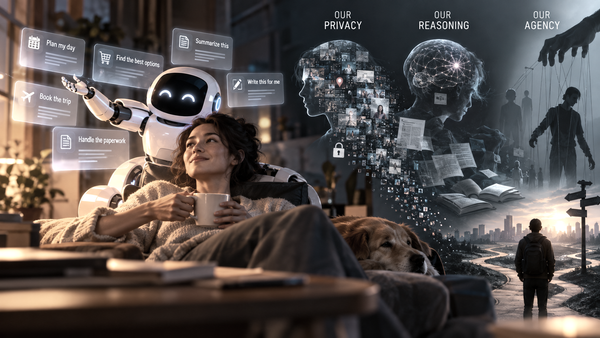
I use AI almost every day. It saves me time. It helps me find gaps in an argument, clean up code, compare ideas, and get past routine work.
It also makes it very easy to skip the part of a task that might have made me better at it.
That is the trade we are underestimating.
Intelligence is not just having the right answer in front of you. It is the ability to form a useful question, sit with uncertainty, retrieve something from memory, compare weak options, notice a contradiction, and change your mind.
These are not fixed possessions. They are habits. They grow through use and fade through neglect.
AI can now perform many of these actions for us. It can frame the problem, generate the alternatives, rank them, explain the ranking, and write the final response. The result may be perfectly good. Sometimes it is better than what we would have produced alone.
But producing a good result and developing a good mind are not the same thing.
There is a difference between removing labor and removing practice.
What Bach was doing every week
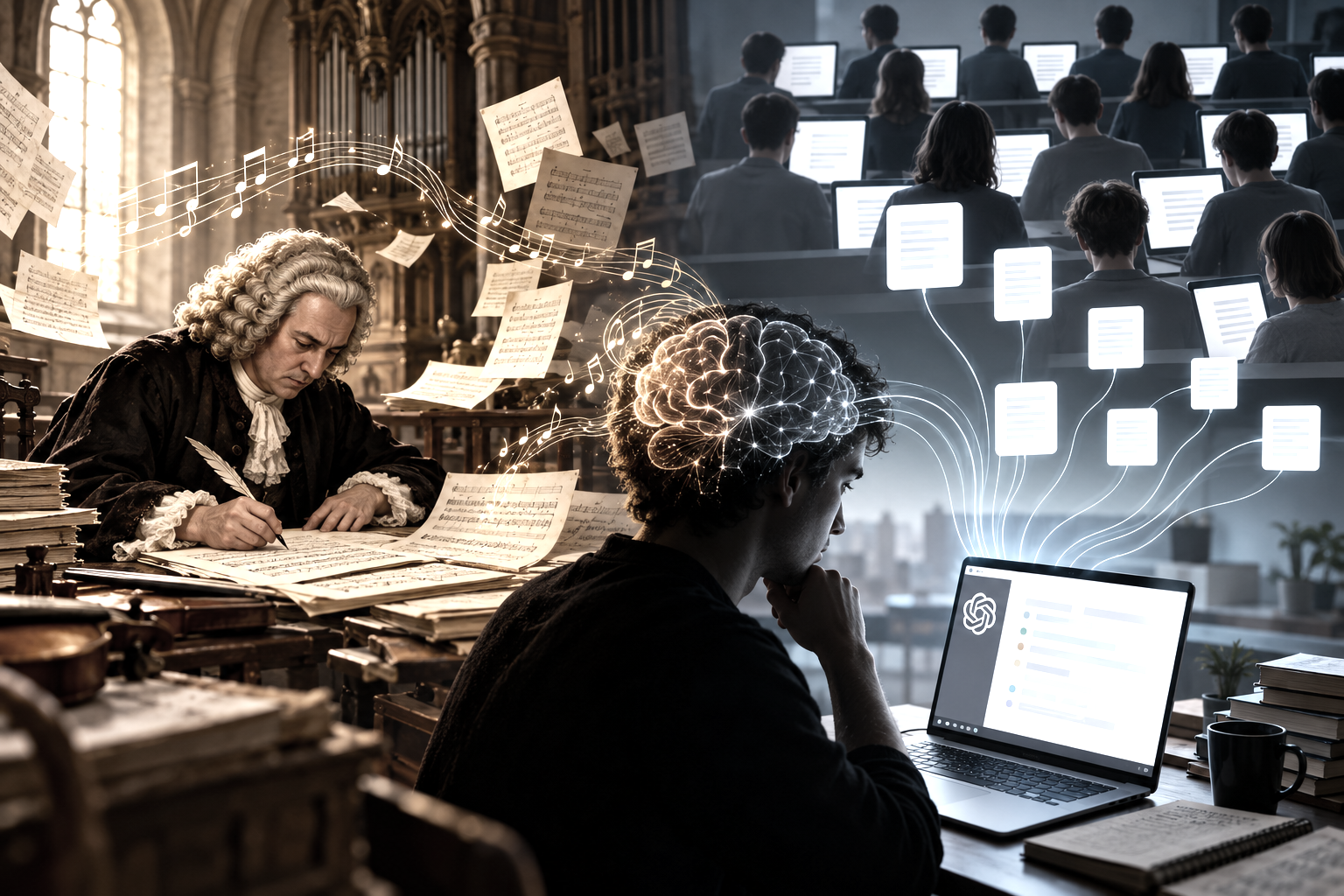
When Johann Sebastian Bach arrived in Leipzig in 1723, he began an extraordinary period of musical production. During his first year, he presented at least one cantata a week. Many were newly composed, while others reworked earlier material. Church holidays created still more demands. He was not simply writing notes. He had to prepare parts, rehearse musicians, work around the limits of particular singers and instruments, and produce something suitable for a specific Sunday. Then he had to do it again.
Think about what that schedule required.
Every week brought another text, another emotional problem, another set of musical decisions. How should this line move? Where should the choir enter? Which instrument should carry the tension? How much complexity could the performers manage? What had worked the previous Sunday, and what had fallen flat?
The deadline forced Bach to make thousands of decisions. Those decisions became part of him. Each cantata did more than fill a slot in the church calendar. It expanded the musical system inside his head.
Now imagine giving Bach a machine that could instantly suggest the harmony, develop the counterpoint, arrange the instruments, and prepare a polished first draft.
He might have produced more music.
But what would he have stopped learning?
This is not an argument for needless suffering. Bach would probably have been happy to avoid copying parts by hand. No one becomes wiser by spending an afternoon adjusting page margins or fixing formatting.
Some friction is merely waste.
Other friction is formative. It changes the person doing the work.
We are not very good at telling the difference.
AI reaches higher than earlier tools
People often compare AI with calculators. The calculator did not destroy mathematics, so why should AI damage writing, reasoning, or creativity?
The comparison is too simple.
A calculator removes arithmetic. It usually does not decide which problem matters, which assumptions are reasonable, or how the result should be interpreted.
Generative AI reaches much higher into the process. It can choose the structure of an argument, suggest the research question, summarize the evidence, produce the examples, adjust the tone, and decide what deserves emphasis.
It can do the intellectual setup as well as the mechanical work.
That is why the risk is different. We are not only outsourcing execution. We are outsourcing the formation of judgment.
A person can use AI to produce a convincing explanation of something they do not understand. They can submit working code they could not debug. They can present a strategic plan without having wrestled with the trade-offs inside it.
The work looks finished. The learning never happened.
Early research reflects this tension. A study of knowledge workers found that greater confidence in generative AI was associated with less reported critical-thinking effort. The work did not disappear, exactly. It shifted toward checking, integrating, and supervising the machine’s output.
That can be a valuable skill. But supervision becomes shallow when the supervisor lacks the ability to reconstruct the reasoning.
You cannot reliably judge an answer that is far beyond your own understanding. Fluency makes this worse. AI often sounds most convincing at the moment when we should be most suspicious.
A higher floor and a narrower room
The second problem is diversity.
AI can help an individual generate more ideas. Yet when many people use the same systems, their ideas can begin to resemble one another.
In one experiment, writers who received AI-generated story ideas produced stories that readers judged to be more creative, better written, and more enjoyable. The largest gains went to people who had initially scored lower on creativity.
That sounds encouraging, and it is.
But the AI-assisted stories were also more similar to one another. Individual performance improved while the collective range of ideas became narrower.
This is the central paradox of generative AI: it can raise the average while reducing the spread.
More recent work has found similar patterns in essays and other forms of expression. Groups of human writers tend to add more genuinely different ideas as the group grows. AI-generated writing may look varied one piece at a time, but across hundreds of pieces, the same conceptual shapes return.
That makes sense. These systems learn from existing patterns and are built to produce plausible continuations. They are very good at giving us something recognizable, coherent, and acceptable.
Those are useful qualities. They are not the same as difference.
Ask an AI system for ten product ideas and it will give you ten items. Yet the ideas often live in the same neighborhood. Ask for ten versions of an email and you get different sentences carrying roughly the same social posture: polished, measured, friendly, and strangely bloodless.
The list creates the feeling of choice. But the boundaries of the choice have already been drawn.
A menu is not diverse merely because it has many items.
The missing sixth option
Suppose you ask AI to recommend five career paths.
You read the list and choose the third. It feels like a decision. In one sense, it is.
But you did not construct the space in which the decision took place. You did not decide which possibilities belonged on the list, which strange option deserved consideration, or whether the question should have been about careers at all.
The unusual sixth option never appeared.
This is how choice can shrink without feeling restricted. We are offered several reasonable alternatives, so we experience freedom. Yet all the alternatives have passed through the same model, the same training patterns, and often the same assumptions about what a good life, a professional email, a successful company, or an attractive design should look like.
The effect can spread from choices into behavior.
Our résumés begin to sound alike. Our presentations follow the same rhythm. Apologies become perfectly balanced statements of regret, context, and forward action. Student essays adopt the same calm, competent voice. Every business describes itself as clear, human-centered, and committed to meaningful impact.
Nothing is obviously wrong with any one example.
That is what makes the change hard to notice.
Diversity rarely disappears because someone bans it. It disappears because one way of speaking and thinking becomes easier than all the others.
We may confuse access with ability
AI gives us access to capabilities we do not personally possess.
That is often wonderful. A small business owner can analyze data without hiring a full team. A scientist can work across unfamiliar literature. A programmer can enter a new language more quickly. Someone writing in a second language can communicate with greater confidence.
But access can create an illusion of ownership.
I can use AI to translate a paragraph into Japanese. That does not mean I know Japanese. The distinction is obvious there.
It becomes less obvious when the task is analysis, writing, or strategy. After reading a polished answer generated from our prompt, we may feel that we understand the subject. Often we merely recognize the explanation.
Recognition is much easier than recall. Following an argument is easier than constructing one. Selecting an option is easier than creating the option space.
One randomized study found that students who used ChatGPT freely as a study aid retained less information on a test 45 days later than students who used traditional methods. That is one study, not a final judgment on AI and learning. Still, it points to a familiar principle: effortful retrieval and reconstruction help knowledge stick. When the answer arrives too quickly, the mind may never build its own path to it.
The lesson is not that AI always weakens thinking. Other studies have found that structured AI use can improve learning and critical thinking when the system asks questions, encourages reflection, and leaves key reasoning steps to the learner.
The design of the interaction matters.
So does the intention of the user.
Let the human make the first move
A simple rule helps: let the human make the first move.
Write the rough paragraph before asking AI to improve it. Form your own hypothesis before requesting alternatives. Sketch the design before generating images. Try to recall the concept before asking for an explanation. Name your decision criteria before requesting recommendations.
Then use AI aggressively.
Ask it to find weaknesses. Ask for counterarguments. Ask what you may have missed. Use it to create variations, test assumptions, locate evidence, or expose the limits of your first idea.
This order matters because the first suggestion becomes an anchor. Once a clean answer appears on the screen, it is difficult to return to the more uncertain space that existed before it.
AI is often more valuable as a critic than as an originator.
It can also help preserve diversity, but we have to ask for more than superficial variety. “Give me ten ideas” is not enough. Ask for ideas based on conflicting values. Ask how people from different places, professions, ages, or intellectual traditions might frame the problem. Ask for an option that rejects the assumptions behind the original question.
Then step away from the list and add something of your own.
Keep parts of life unoptimized, too. Read a book without requesting a summary first. Walk through an unfamiliar neighborhood without asking for the top five stops. Write a private note in your natural voice. Solve some problems without assistance, especially the ones that sit near the edge of your current ability.
Not because old methods are morally superior.
Because you need to know which abilities are still yours.
The point is not to preserve struggle
I do not want less AI. I want a clearer sense of which work should be handed over and which work should remain ours.
Let the machine remove clerical repetition. Let it handle conversions, formatting, transcription, routine searches, and the first pass through a large pile of material.
But be careful with generative repetition: the repeated acts of composing, deciding, recalling, comparing, and revising that slowly produce judgment.
Bach’s weekly cantatas matter for more than their number. Each one was a finished work, but each was also another week of becoming Bach.
That is what we risk losing when every blank page is filled before we have faced it.
AI can make our output look more intelligent. It can make our choices look more abundant. Meanwhile, our own capacity to think, choose, and differ may quietly contract.
The answer is not rejection. It is practice.
Use the machine. Just do not give it every repetition that was supposed to change you.
Self-Reflection AI is a brand new site by Carlos Morato that's just getting started. Things will be up and running here shortly, but you can subscribe in the meantime if you'd like to stay up to date and receive emails when new content is published!