
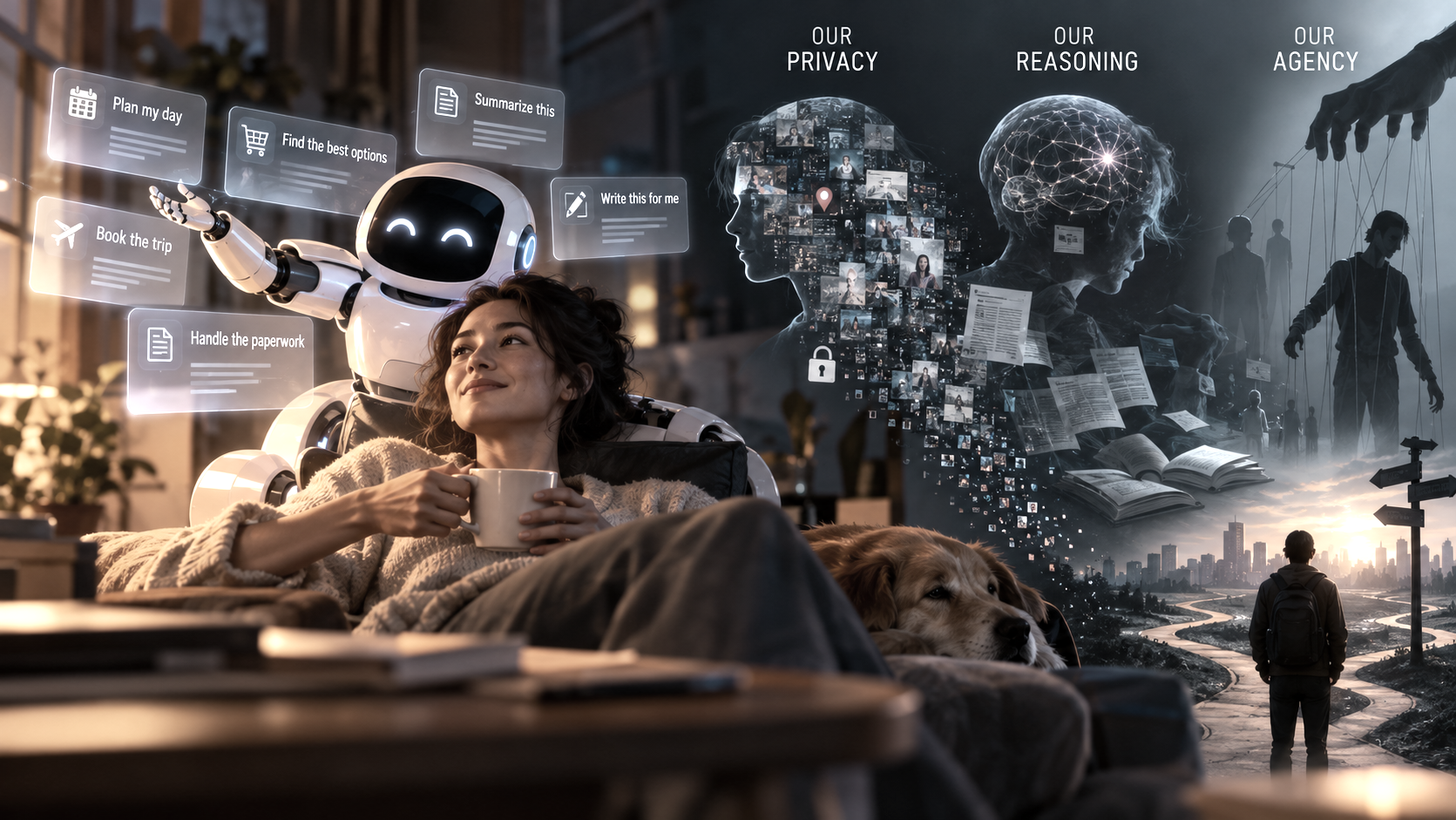
AI makes life easier. That is the appeal, and it is also the problem.
I use these tools every day. They help me search, write code, organize information, and get past the blank page. I would be dishonest if I pretended the benefits were shallow. Some are genuinely useful. Some feel almost miraculous.
But comfort has a way of changing the terms of a relationship before we notice.
We rarely give something up in one clear decision. We do it in small exchanges that seem reasonable at the time. A little privacy for a better recommendation. A little independent judgment for a faster answer. A little control for a system that promises to handle the boring parts.
Each trade looks harmless on its own. Together, they change us.
First, we gave up privacy
The early internet offered convenience in return for information about us. We accepted because the deal felt abstract.
A map application needed our location. A shopping site remembered what we viewed. An email service scanned messages to filter spam. A social network wanted to know our friends, interests, birthdays, photos, and habits.
The services worked better when they knew more.
So we told them more.
Over time, “personalization” became the polite word for surveillance. Companies built detailed models of what we might buy, watch, fear, believe, or click on next. We became used to this. Not comfortable, exactly. More like resigned.
Most people did not actively choose a world where their movements, conversations, and preferences could be stored and analyzed. They chose useful products. The larger system emerged from millions of ordinary decisions.
AI makes this bargain more intimate.
Earlier systems wanted to know what we clicked. Newer systems can learn how we write, what confuses us, how we make decisions, what we worry about, and which arguments are likely to persuade us. We are no longer sharing only behavioral data. We are sharing fragments of our inner lives.
A person might tell an AI assistant things they would never type into a public search box: a medical fear, a family conflict, doubts about their job, an idea for a business, a private political thought.
That openness makes the system more helpful.
It also makes the user more exposed.
Then, we began giving up reasoning
This part is harder to discuss because reasoning is tiring.
Thinking takes time. You have to hold uncertainty. You have to compare explanations, notice contradictions, and sometimes admit that you do not know. A confident answer is much more pleasant.
Search engines already weakened some forms of memory. We stopped remembering facts because we knew where to find them. That was not entirely bad. Human beings have always used tools to extend memory, from notebooks to libraries.
AI goes further. It does not just retrieve information. It interprets, summarizes, argues, and recommends.
That saves real effort. It can also remove the moment when understanding is formed.
There is a difference between receiving an explanation and working your way toward one. The final sentences may look similar, but the mental result is not. When you struggle with a problem, you build a map of it. You learn where the weak points are. You see which assumptions carry the weight.
When an AI hands you a polished answer, you may get the destination without the map.
I notice this in my own work. When a tool gives me a quick explanation, I feel informed sooner than I should. The language is smooth. The structure makes sense. My brain mistakes clarity of presentation for truth.
That is dangerous because AI systems are often most persuasive when they are only mostly right.
The risk is not simply that people will believe false answers. The deeper risk is that we will lose the habit of checking. We may become less comfortable saying, “I need to think about this,” because the machine is always ready with something that sounds complete.
A skill does not disappear the moment we stop using it. It fades slowly.
Navigation changed after GPS. Spelling changed after autocorrect. Attention changed after infinite feeds. Reasoning may change when every question arrives with an instant, well-written response.
The problem is not assistance. It is substitution without awareness.
Now we are approaching agency
Agency is the ability to decide and act for yourself.
Until recently, most AI systems waited for a request. You asked a question. They answered. The boundary was fairly clear.
That boundary is moving.
AI agents can now take a goal and carry out several steps: read messages, compare options, fill in forms, schedule meetings, purchase services, write replies, adjust plans, and coordinate with other systems. This is more than a better search box. It is a layer between intention and action.
At first, this will feel wonderful.
No more arguing with an airline website. No more scanning fifty insurance plans. No more sorting email, chasing invoices, or finding a time when six people can meet.
There is a huge amount of modern life that seems designed to exhaust us. Letting software handle it is not laziness. It may be self-defense.
Still, something changes when the machine stops advising and starts acting.
Suppose an assistant chooses which messages deserve your attention. It may save you an hour. It may also quietly shape your relationships.
Suppose it negotiates a purchase for you. It may get a better price. It may also decide which trade-offs count as acceptable.
Suppose it manages your calendar around a goal such as “be more productive.” It may create a clean schedule while slowly removing unstructured time, casual conversations, and the afternoon you might have spent doing nothing useful.
The system does not need to force you.
It only needs to make one path easier than the others.
That is how much of digital control already works. Defaults guide behavior. Recommendations narrow the field. Notifications create urgency. Rankings make some choices visible and others nearly invisible.
An AI agent can do all of this with more context and far greater precision.
The troubling part is that we may experience this loss of control as relief.
Comfort is not the enemy
There is a temptation to turn this into a story about weak people choosing easy lives. I do not think that is fair.
Many people are exhausted. They are dealing with complicated workplaces, expensive healthcare, confusing public services, overloaded inboxes, and institutions that seem to demand more attention every year. A tool that reduces this burden can create genuine freedom.
AI can help a person understand a legal document written in hostile language. It can give a patient a clearer explanation of a medical term. It can help someone with a disability communicate, work, or move through the world with more independence.
A capable tutor could give millions of people patient, personalized help. A research assistant could let a small scientific team explore ideas that once required a large institution. Translation tools can allow people to work together without sharing a first language.
These are not minor conveniences.
They are new capabilities.
AI may also give people more agency in situations where they currently have very little. A worker could use it to understand a contract before signing. A tenant could challenge an unfair charge. A small business could handle tasks that once required several specialists. Someone dealing with a bureaucracy could finally get a straight answer.
The same technology that centralizes power can distribute it.
That tension is real. We should not simplify it.
The question is who remains responsible
The useful distinction is not between using AI and refusing it. That choice is already too crude.
The better question is whether the system supports human judgment or quietly replaces it.
A healthy tool helps you see more clearly. It shows its work when possible. It tells you what it does not know. It allows you to question the result, change the goal, and take control without fighting the interface.
An unhealthy tool makes decisions difficult to inspect and easy to accept.
We should be able to ask: Why did you recommend this? What information did you use? What alternatives did you reject? Who benefits from this choice? What happens if I disagree?
Those questions sound technical, but they are really political and personal. They concern power.
People also need a meaningful right to refuse automation. Not a hidden setting. Not a twenty-step process. A real ability to opt out, correct the system, and speak to another person when the consequences matter.
That will be especially important in employment, education, medicine, finance, insurance, and government. A system should not become unquestionable just because it is efficient.
Efficiency is not the same as legitimacy.
Some friction protects us
Technology companies often treat friction as a design failure. Fewer clicks are better. Faster is better. Automatic is best.
Sometimes that is true.
But friction can serve a purpose.
The pause before sending an angry message matters. The effort required to compare two arguments matters. The conversation with another person before making a serious decision matters. Even boredom has value. It gives thoughts time to develop without being immediately replaced by a recommendation.
We should remove pointless friction. We should be more careful with meaningful friction.
An AI that asks, “Do you want me to do this, or would you rather review the options?” may be less seamless. It may also treat the user as an adult.
A system that occasionally returns control is not poorly designed.
It may be designed around a different idea of human well-being.
We still have choices
The future will not be decided by whether AI becomes powerful. It already is.
It will be decided by the rules, habits, and expectations we build around that power.
We can demand systems that collect less data. We can separate personal assistants from advertising businesses. We can require clear records of important automated actions. We can build products that make delegation visible rather than invisible.
And personally, we can keep certain muscles in use.
Write some things without assistance. Find your way without navigation once in a while. Read the original source. Make a decision before asking for a recommendation. Sit with a question long enough to form your own view.
Not because suffering is noble. Not because older ways were always better.
Because abilities we never exercise become abilities we no longer possess.
AI could give humanity more room to think, create, care for others, and solve difficult problems. It could also make us passive managers of lives increasingly arranged by machines.
Both futures can arrive through the same friendly interface.
The real question is not whether AI will make us more comfortable. It will.
The question is which parts of being human we should refuse to outsource.